How American Was Colonial Art? To What Extent Does It Illustrate the Development Course Hero
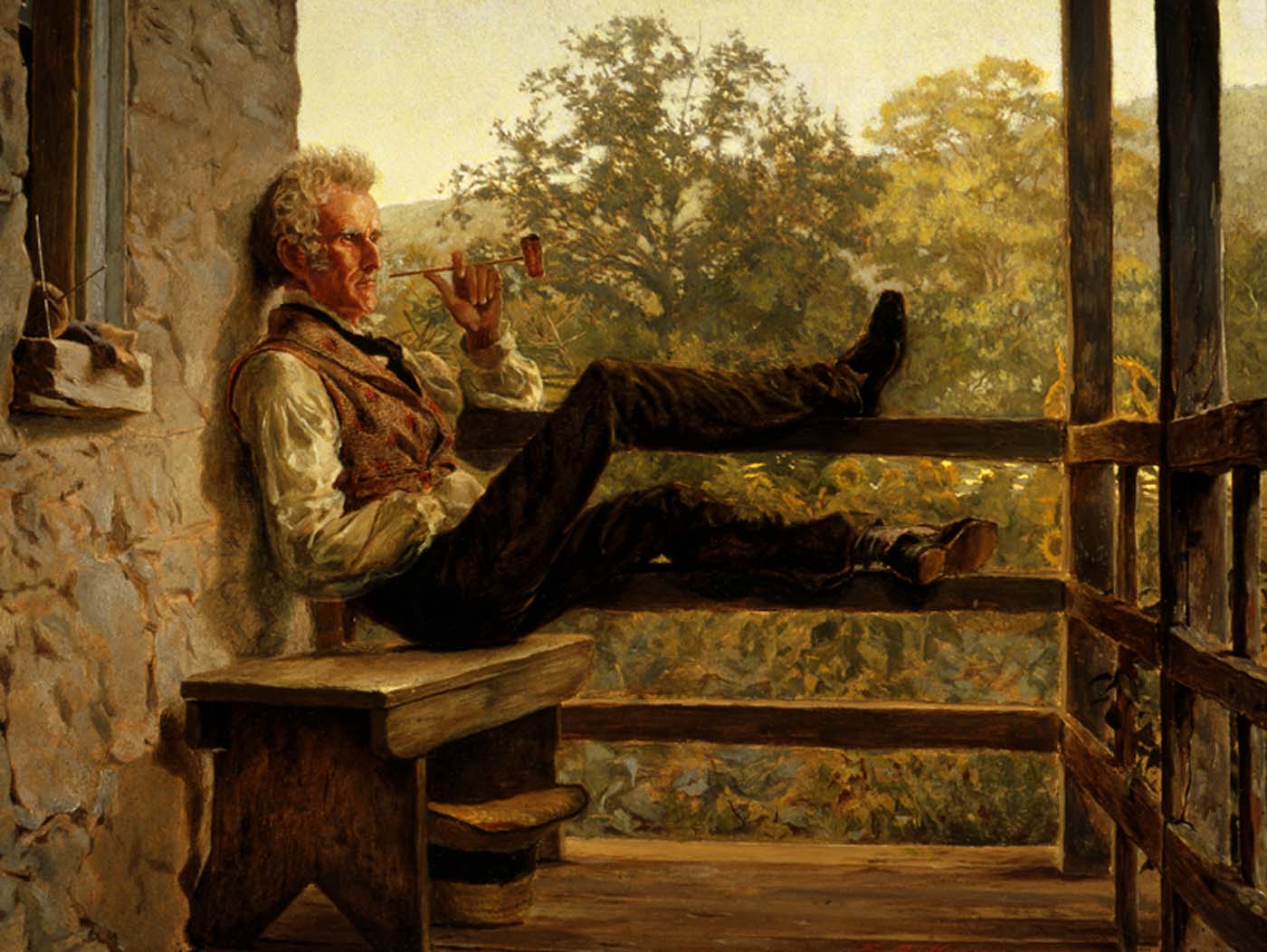
Independence (Squire Jack Porter), 1858, Frank Blackwell Meyer
Download Image
The finish of the Revolution and the dawn of the nineteenth century brought much societal alter in America. Out was the time of the aristocratic gentleman and in was the self-made man; ane who did not inherit his fortune, but toiled the earth and reaped the benefits of independence fought for in the previous decades. Americans of this era were beginning to create their ain identity, leaving the trappings and traditions of Europe behind. Daniel La Motte echoes these old earth trappings in the formality of his portrait and formal apparel, whereas Squire Jack embodies the Jacksonian-era "common man," casually posing on his front porch surveying his country, corn-cob pipe in hand.
Having re-asserted the new nation's sense of independence after battling the British a second fourth dimension in the War of 1812, the ballot in 1828 of Andrew Jackson indicated a shift towards more democratic ideals. While previous presidents rose to political prominence through family groundwork, landed wealth in the original thirteen colonies, and teaching, Jackson's humble background and Tennessee roots fabricated his ascension to the presidency a powerful metaphor for the cocky-reliance of the "common man." During the Jacksonian Era, white men who did not own land gained the right to vote, and therefore more political power. Economically, American reliance on international merchandise with Europe began wane, in favor of the growth of industry and agriculture at home.
Activity: Observe and Interpret
Artists brand choices in communicating ideas. Both Thomas Sully's portrait, Daniel La Motte, and Frank Blackwell Mayer's Independence, Squire Jack Porter illustrate the sitter's relationship to the land. How practise the artists convey this connexion? The portraits recall a time in U.s.a. history when the idea of democracy was shifting. Growth, expansion, and social change pushed the American population westward, and a greater level of equality arose in the western states than at that place had been in the eastern colonies. The definition of democracy began to change, as western states led the way by not having property requirements for voting. Think virtually how the definition of democracy has changed over time. How exercise these paintings illustrate that? In the context of the era of the " Common Man " that the ballot of President Andrew Jackson represented – how might comparing and contrasting these 2 portraits illustrate this modify?
Observation: What do yous run into?
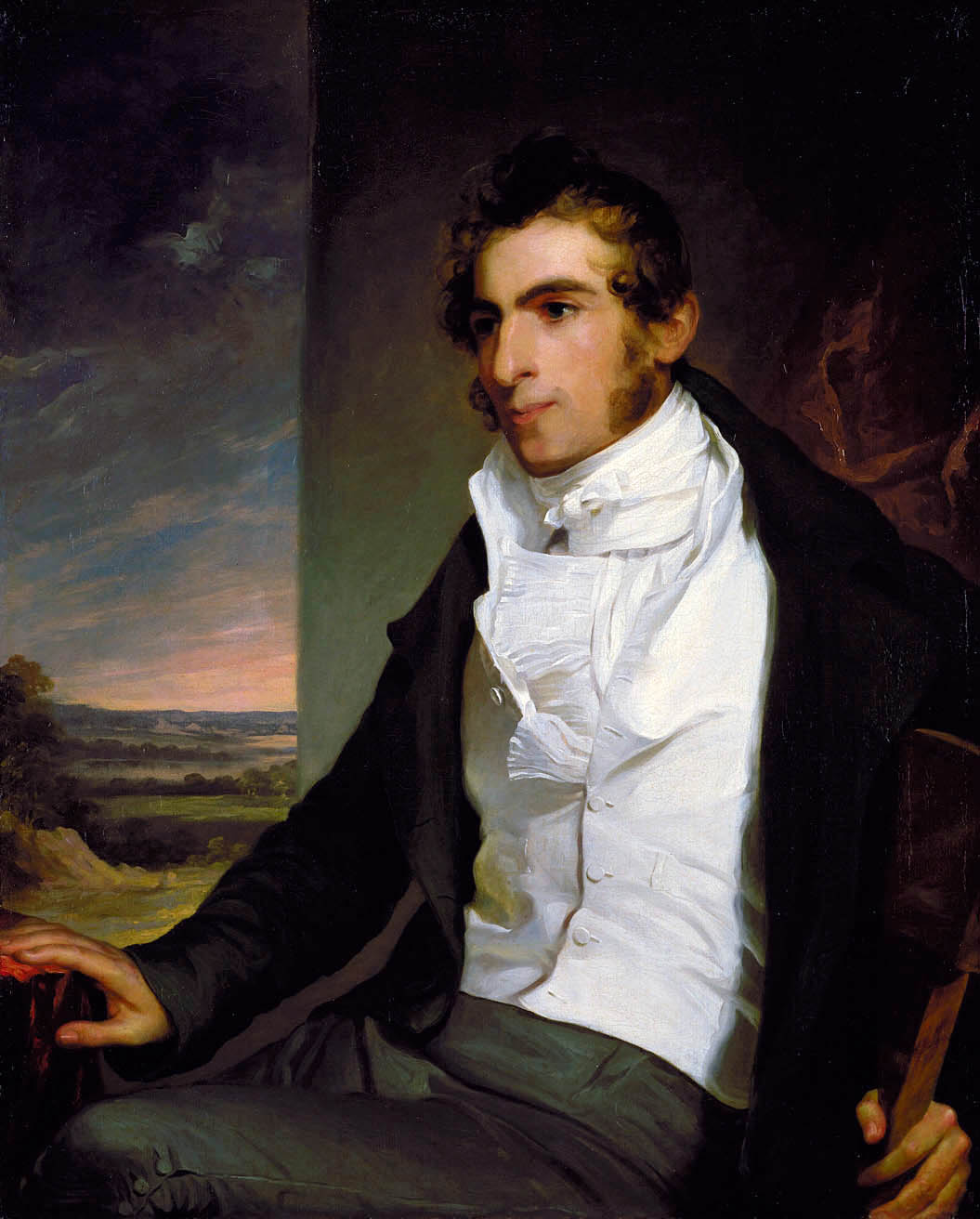
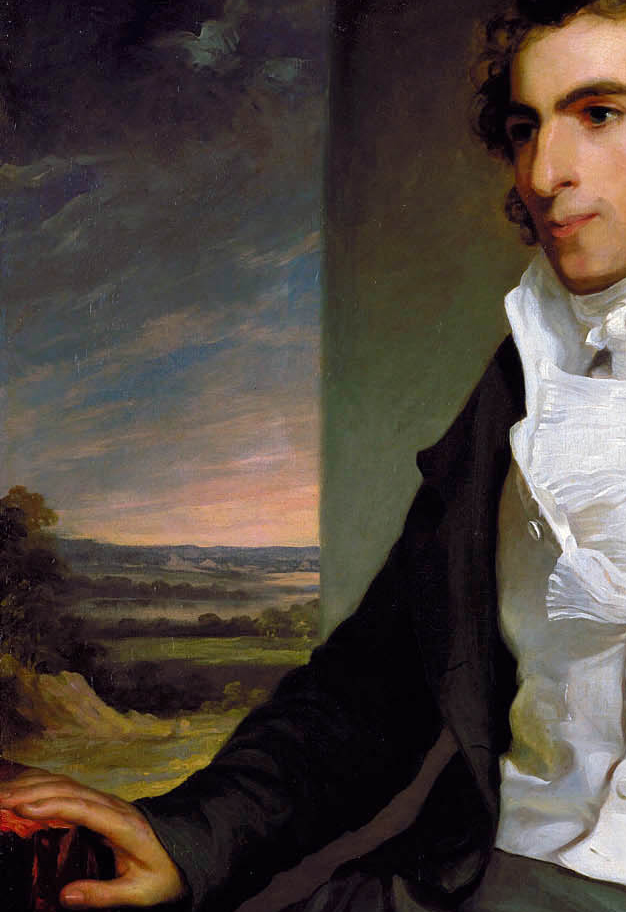 What does the landscape behind Daniel La Motte suggest nigh the man in the portrait?
The casual elegance of the sitter reflects Sully'southward close report of eighteenth-century British portrait traditions in which aloof men and women were posed earlier landscape vistas, suggestive of their vast estates. The man in the portrait, Daniel La Motte, was a Baltimore merchant whose land holdings were extensive. Seen through the open up window is his extensive property. A river is seen stretching far into the securely shaded horizon.
What does his attire tell us virtually his social class and economic status?
Seated in a chair, Daniel La Motte is dressed in a fashionable sage light-green glaze, white waistcoat, and ruffled shirt tied with an elaborate neckcloth. A rose-colored drapery flutters behind him. Portrayed as a gentleman, he benefits from land ownership simply appears far removed from its twenty-four hours-to-day maintenance. LaMotte's introspective gaze and posture indicate a superior social position also as education. Sully's conscientious choice of pose, backdrop, and costume create the impression of aristocratic wealth and birth.
How does the portrayal of Squire Jack Porter differ from that of Daniel La Motte?
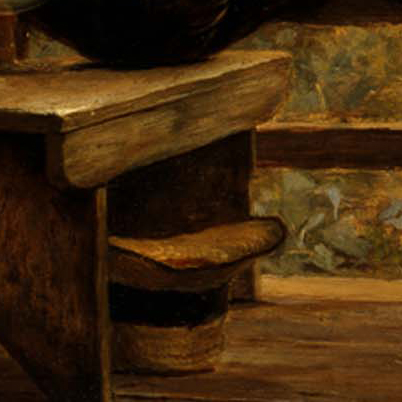
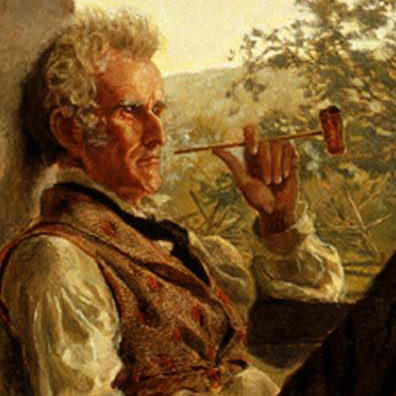 Whereas Daniel LaMotte is portrayed as a gentleman in the European way and every bit lord of his estates, Squire Jack Porter in his very breezy pose, is shown as a man integrally united with his country. Smoking a corncob pipe, he gazes intently into the altitude, his feet propped up on a rough-hewn wooden railing. His wide-brimmed harbinger hat, worn to shield him from the sun, lies below the bench. How-do-you-do rugged features and casual pose share an affinity with the mount range seen through the railing. He wears the breeches of a working man, a farmer'due south tunic, and vest. A brawl of yarn and knitting needles on the window sill suggest the presence of a woman—perhaps Squire Jack Porter's wife or girl—who share his life on the estate.
 Mayer'due south painting shows a cocky-fabricated man. Porter relaxes while gazing out over the state that he has turned into a profitable farm. His tanned face and gnarled hands demonstrate hard labor in a way that La Motte's delicate complexion and calculated pose exercise not. Everything in the painting—firm, demote, dress, and pipe—has a quality that speaks of the squire'due south self-sufficient approach to life and the land. Independence is an affidavit both of Thomas Jefferson 'southward ideal of an agrestal democracy and Jackson'due south policies that fabricated it easier for the lower and middle classes to obtain land.
Interpretation: What does it mean?
Having re-asserted the new nation's sense of independence after battling the British a second time in the War of 1812, the election in 1828 of President Andrew Jackson indicated a shift towards more democratic ideals. While the previous six presidents rose to political prominence through family background, landed wealth in the original thirteen colonies, and education, Jackson's humble background and Tennessee roots made his rise to the presidency a powerful metaphor for the self-reliance of the "mutual man," or self-made man. During the Jacksonian Era , white men who did non own land gained the right to vote, and therefore more than political power. Economically, American reliance on international trade with Europe began wane, in favor of the growth of manufacture and agriculture at dwelling. This duality between the aristocrat and the common man can exist seen through the advisedly equanimous portraits of Daniel La Motte and Squire Jack Porter.
Download (PDF)
Historical Background
Federalism to Jacksonian Democracy
 Independence from U.k. acquired leaders of the American Revolution to face the problem of establishing a national authorities while at the aforementioned time maintaining the rights of u.s.. A national government based on a loose union of states was formed nether the Articles of Confederation , merely debt and regional factionalism threatened to dissolve it. The Great Compromise of 1787 balanced the interests of u.s. with big populations and those with pocket-size ones by dividing a new national legislature into ii bodies or houses. In this arrangement, the lower house was to correspond united states of america co-ordinate to population; in the upper firm, the senate, all the states were represented equally, though senators were not to be directly elected past the people in the program. A " federalist party" favored a stiff central authorities drafted in a proposed new "constitution." The anti-federalists, fearing that a president or chief executive might become an oppressive dictator, or king, opposed the adoption of the constitution without guarantees that personal liberties would exist protected. Subsequently a convention and conscientious drafting of the constitution, a questionable political strategy on the office of the Federalists led to the ratification of the document past each of the original thirteen colonies by 1790.
Federalists and non-Federalists, about of whom were among the nation'south economic elite, believed that wealthy, well-educated men should govern. The nation'south first 2 presidents, George Washington and John Adams , supported the buying of land every bit a prerequisite to vote, as did Thomas Jefferson and James Madison . Land was a major economic resource. Information technology was the determiner of social condition and source of political power. It created nigh American fortunes in the eighteenth and early nineteenth centuries, provided the basis for American economic development, and fueled public and private business transactions. Men like Daniel La Motte (in the portrait Daniel La Motte) would have been an ideal candidate for the role of governing the new nation. Equally a member of the economic elite, La Motte was a merchant based in Baltimore, and later in Philadelphia. He was related past marriage to the DuPont family, i of the richest families in nineteenth century America and atomic number 82 manufacturers of gun powder in the land. La Motte'south portrait by famed English language portrait painter Thomas Sully is emblematic of this elite economic class. Dressed in gentleman'southward attire, he is positioned in front end of a window overlooking his vast land holdings – a visible and tangible symbol of his wealth.
With the inauguration of Jefferson in 1800, the Democratic-Republican Political party came to ability. In his countdown address, Jefferson vowed to promote the "equal and exact treatment of all men." Jefferson opposed the proliferation and growth of cities and instead promoted the ideal of a peaceful agrarian nation governed through local assemblies. This view differed from the Federalist Party ideal of a government dominated past a wealthy elite.
Yet, the shift from Federalism to Autonomous-Republicanism did not provide as big of a change as some probable hoped. Property owners with formal education and experience in managing estates were still thought to be the best qualified people to govern the new nation during Jefferson's administration. Women, African Americans, Native Americans, and most tenant farmers were unable to vote or participate in government. By the early 1800s farmland became scarce and expensive, preventing many settlers from acquiring country and the right to vote. The authorities of the new nation remained in the control of an elite of wealthy and well-educated men through the administration of John Quincy Adams .
Jacksonian Democracy and the Common Human being
The 1820s brought with information technology a radical change in the political atmosphere. The shift to a Jacksonian Democracy began afterwards a long and arduous presidential campaign, when Andrew Jackson defeated the incumbent John Quincy Adams in the election of 1828. Jackson ran every bit the champion of the common man and equally a state of war hero. He was the hero of the Boxing of New Orleans of 1815, which was one of the few country victories of the War of 1812 and was actually fought afterwards the peace treaty was signed. As a native of Kentucky, Jackson was the beginning president to come from the borderland, outside the traditional centers of political ability — Virginia and New England. Although Jackson represented the aspirations of the middle and lower classes, he was able to attract voters from all social sectors. Jackson felt that hardworking, motivated men should be allowed to reach the same degree of fiscal and political success equally those who inherited wealth. By the belatedly 1820s, almost all states had ended the holding requirements for voting for white males. Increased literacy and effective political advertising were as well of import factors in the ballot'south event. Every bit a upshot, the number of voters participating in 1828 doubled from the election of 1824.
Jacksonian Democrats believed that industrialization was essential to the progression of American industry – a far weep from Jeffersonian Democrats like Daniel La Motte who feared the consequences of industrialization and believed that the chosen class was the yeoman farmer, not the planter or common laborer. The portrait of Squire Jack Porter embodies an contained and enduring spirit that, by the 1850s, had get an American platonic: an prototype allegorical of Jacksonian Democracy's self-made, " Common Man " which was historic by painters and writers akin. Squire Jack Porter was one of the pioneer settlers of Alleghany Canton, Maryland. Following his service as a helm during the State of war of 1812, Porter and his family settled on a farm exterior of Eckhart, Maryland called "Rose Meadows," named for its profusion of wild roses. Porter made his living opening up coal mines on his property – the first mines opened for domestic use in Allegany County.
Porter's dwelling house was known for its hospitality, having been known to always "go on a plate for the stranger." It was at Rose Meadows in the early 1850s that celebrated Baltimore creative person Frank Blackwell Mayer painted this portrait of Squire Jack Porter. Mayer aptly evokes Porter's leisure years, fiscal well-being, and strength of character. Seventy-five years old at the fourth dimension, Porter is depicted lounging on the porch of his farmhouse. Every bit described by the creative person, the painting shows Porter "on the porch of his stone cottage farm house in his shirt sleeves, smoking a corn-cob pipe, one foot comfortably resting upon the balustrade of the veranda, the other on the flooring of the porch. . . looking out over his farm, his countenance depicting satisfaction, comfort and independence." Everything in the painting—house, bench, wearing apparel, and pipe—has a quality that speaks of the squire's cocky-sufficient arroyo to life and the land. Independence is an affirmation both of Jefferson's platonic of an agrestal nation and Jackson'southward policies that made it easier for the lower and middle classes to obtain state.
Download (PDF)
Artwork Connections
 Southeast View of "Sedgeley Park," the Land Seat of James Cowles Fisher, Esq., ca. 1819, Thomas Birch
Thomas Birch painted Sedgeley Park for its owner, James Cowles Fisher. Fisher served as interim president of the second Bank of the United States. The painting was executed in 1819, the twelvemonth of the economical panic. Fisher conspicuously wanted Birch to represent his family in a dignified natural setting oblivious to the economical distress. The image suggests that Fisher's genteel being will survive the panic. In the wake of the panic, however, the general public became less interested in viewing landscape painting that chronicled a luxurious style of living enjoyed past a privileged few.
 Long Island Homestead, Written report from Nature, 1859, Andrew W. Warren
Andrew Warren's small written report, executed at the scene, shows this fairly large subcontract every bit a self-sufficient, harmonious microcosm; a model of America's agrestal wealth. The wheat field is not very all-encompassing, suggesting that it is for the family's own consumption. The homestead's self-sufficiency straight contrasts with the emerging urban earth of specialization and interdependence.
Media
Federalism: Crash Course Government and Politics – PBS
This PBS video teaches you lot about federalism, or the idea that in the The states, power is divided betwixt the national authorities and the fifty state governments. You volition larn about how federalism has evolved over the history of the The states, and what powers are given to the federal government, and what the states control on their own.
Boosted Smithsonian Resources
Exploring all xix Smithsonian museums is a great way to enhance your curriculum, no affair what your discipline may be. In this section, you'll find resources that we accept put together from a variety of Smithsonian museums to heighten your students' learning feel, augment their skill set, and not but meet education standards, just exceed them.
Glossary
agrestal democracy: a philosophy advocated by President Thomas Jefferson in which a rural society is seen as superior to an urban society. It values the contained farmer as superior to the paid laborer. The philosophy values farming every bit a style of life which can shape ideal social values.
Andrew Jackson: (1767-1845) 7th President of the Us, military machine general, governor, and senator. He is most well-known as the founder of the Autonomous Party, and for his controversial passage of the Indian Removal Act of 1830. He epitomized the "Mutual Human being," or self-made man, of the nineteenth-century, having been the first U.Due south. president to non have been built-in into a wealthy, aristocratic family unit or to accept received a formal education.
Manufactures of Confederation: (1781) a written understanding by the 13 original states that provided a legal symbol of their union by giving the central government no coercive ability over united states or their citizens.
Battle of New Orleans: (January 8-15, 1815) the final major battle of the War of 1812. The American forces, commanded by so-General Andrew Jackson, prevented a much larger, combined British-American Indian force from capturing New Orleans.
Common Homo: the everyday, working class man – non a wealthy landowner or man of ability like a political leader. Andrew Jackson, despite his high office, became emblematic of the common man because he came from humble beginnings.
Democratic-Republican Party: an American political party formed by Thomas Jefferson. They supported an agrarian-based, decentralized, democratic government. The party was established to oppose the Federalists who had pushed through the ratification of the United states of america Constitution.
federalist: a member or supporter of the Federalist Party, the outset American political political party. Federalists supported a strong national government, economic growth, and an alliance with Great Uk. They were politically opposed by the Autonomous-Republicans, led by Thomas Jefferson.
George Washington: (1732-1799) 1st President of the United States, Founding Father, Commander-in-Principal of the Continental Ground forces. Known equally the "male parent of his country" during his lifetime.
Great Compromise of 1787: a measure proposed at the U.S. Constitutional Convention of 1787 which created a arrangement of proportional representation in the House of Representatives; too known as the Connecticut Compromise.
Jacksonian Commonwealth: also known as the Jacksonian Era. A move for more democracy in American government. Led by President Andrew Jackson, the movement championed greater rights for the common homo and was opposed to any signs of elite in the nation, Jacksonian democracy was aided by the strong spirit of equality amongst the people of the newer settlements in the South and the West. It was also aided past the extension of the vote in eastern states to men without property; in the early days of the United States, many places had immune only white male property owners to vote.
Jacksonian Era: likewise known as Jacksonian Democracy. A motion for more democracy in American government. Led by President Andrew Jackson, the movement championed greater rights for the mutual man and was opposed to any signs of elite in the nation, Jacksonian democracy was aided past the stiff spirit of equality amongst the people of the newer settlements in the South and the West. It was also aided by the extension of the vote in eastern states to men without holding; in the early days of the Usa, many places had allowed but white male property owners to vote.
James Madison: (1751-1836) 4th President of the United States. He played a pivotal role in drafting and promoting the U.s.a. Constitution and the Bill of Rights.
John Adams: (1735-1826) 2nd President of the U.s.a., lawyer, diplomat, politico, and Founding Father. As a lawyer before the American Revolution, he defended the British soldiers in the Boston Massacre trials. This event catapulted him to notoriety and led to his political interest in the American Revolution.
John Quincy Adams: (1767-1848) 6th President of the United States. American statesman, diplomat, Senator, and member of the U.S. Firm of Representatives; son of the second U.S. president John Adams.
Squire: a human being of loftier social standing who owns and lives on an estate in a rural area, specially the main landowner in such an surface area.
Thomas Jefferson: (1743-1826) iiird President of the U.s., Founding Father, author of the Declaration of Independence, and American lawyer. Jefferson oversaw the buy of the Louisiana Territory from French republic and bundled for the exploration of that territory by Meriwether Lewis and William Clark.
War of 1812: (June 1812-February 1815) a war machine disharmonize between the U.s. and Britain. The U.S. alleged war for several reasons, primary among them the continued impressment of American sailors by the British navy, trade brake brought on by Britain's state of war with France, and British support of Native American Indian tribes who opposed the American government over land disputes.
Standards
U.South. History Content Standards Era 3 – Revolution and the New Nation (1754-1820s)
-
- Standard 2C – The student understands the Revolution'due south effects on unlike social groups.
- v-12 – Compare the revolutionary goals of different groups—for example, rural farmers and urban craftsmen, northern merchants and southern planters—and how the Revolution contradistinct social, political, and economic relations among them.
- Standard 2C – The student understands the Revolution'due south effects on unlike social groups.
U.Due south. History Content Standards Era iv – Expansion and Reform (1801-1861)
-
- Standard 2A – The student understands how the manufacturing plant system and the transportation and market revolutions shaped regional patterns of economical development.
- vii-12 – Evaluate national and state policies regarding a protective tariff, a national bank, and federally funded internal improvements.
- nine-12 – Explain how economic policies related to expansion, including northern potency of locomotive transportation, served different regional interests and contributed to growing political and exclusive differences.
- seven-12 – Evaluate the manufacturing plant arrangement from the perspectives of owners and workers and assess its impact on the ascent of the labor movement in the antebellum period.
- Standard 3A –The student understands the changing character of American political life in "the age of the mutual man."
- 7-12 – Relate the increasing popular participation in state and national politics led to the evolving democratic ideal that adult white males were entitled to political participation.
- 7-12 – Analyze how Jackson's veto of the U.Due south. Bank recharter and his deportment in the nullification crisis contributed to the rising of the Whig political party.
- Standard 4C – The pupil understands irresolute gender roles and the ideas and activities of women reformers.
- 9-12 – Compare the N, South, and Due west in terms of men'south and women'south occupations, legal rights, and social status.
- Standard 2A – The student understands how the manufacturing plant system and the transportation and market revolutions shaped regional patterns of economical development.
Source: https://americanexperience.si.edu/historical-eras/colonization-revolution-and-new-nation/pair-daniel-lamotte-independence-squire-jack-porter/
0 Response to "How American Was Colonial Art? To What Extent Does It Illustrate the Development Course Hero"
Post a Comment